
The rise of the retail prop firm industry
The proprietary trading industry has changed how retail traders approach financial markets. What used to sit mainly with institutional desks is now an industry where an independent trader can buy an evaluation, show a result under a written rule set, and, if they qualify, trade a funded program.
Traders now use futures funding programs from firms including Topstep, MyFundedFutures, Tradeify, FundedNext Futures, and Lucid Trading. The attraction is straightforward. Instead of putting up a large personal account, a trader pays for an evaluation and tries to qualify for a larger allocation under conditions the firm sets in advance.
Passing that evaluation is not the whole business. Anyone considering this route needs to understand how these companies make money, how a funded account actually works, and what has to be true before a payout is eligible. Passing an evaluation and keeping a funded account are different jobs.
That is where systematic trading comes in. At Sovren, the view is that funded trading favors traders who put structure, repeatability, and disciplined execution ahead of decisions made in the moment.
How does the prop firm business model work?
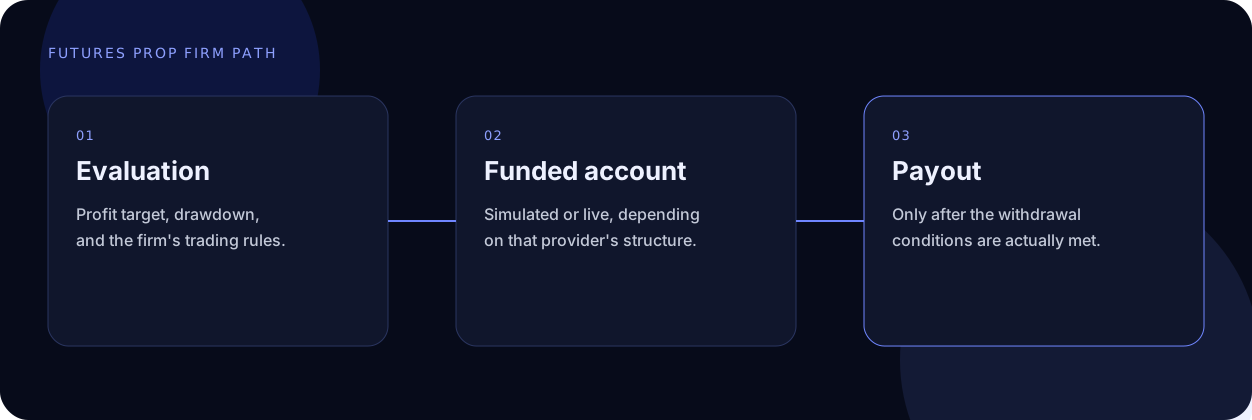
A retail futures prop firm generally sells a structured evaluation and then, if the trader qualifies, a funded account. Firms differ on account types and payout rules. The path still has the same stages.
Evaluation fees and subscriptions
Most futures prop firms start by selling access to an evaluation. The trader pays for a simulated account with a written set of requirements. Those requirements commonly include:
- A specified profit target.
- A maximum account drawdown.
- Minimum trading days.
- Daily loss restrictions.
- Contract position limits.
- Consistency requirements.
Some firms bill a monthly subscription. Others sell a one-time evaluation, sometimes at a promotional price. Resets, activation fees, and data costs can be extra. Evaluation fees are a meaningful part of the revenue for many retail prop firms.
Passing the evaluation
If the trader meets the requirements without breaking the rules, they may move to the next stage. Passing does not, by itself, mean the trader has received live trading capital or earned a profit they can withdraw. What comes next depends on that firm’s account structure.
The funded stage
Many retail futures programs then use a simulated funded account. The trader keeps trading in a simulated environment under the firm’s rules. Some programs use live trading, or move a trader to a live account later. A balance on the screen is not the same thing as cash in a personal brokerage account. Read the account type before you treat the number as money you can take out.
Payouts and profit sharing
After the trader meets the withdrawal rules, they may request a payout. Conditions often include a minimum number of profitable days, a minimum withdrawal amount, a consistency rule, a cap on the withdrawal, an account-specific profit threshold, and compliance with every trading restriction. The firm then pays eligible rewards under its own policy.
A passed evaluation is the start. The job after that is to stay inside the rules, keep the account, qualify for a withdrawal, and repeat the process.
Why do so many traders fail funded challenges?
The usual problem is not that a trader cannot find a setup. It is consistency. Someone can spend months on market structure and Nasdaq futures, then trade differently the moment the account is live and the drawdown is real.
Emotional trading
One loss can change the plan. The next trade is no longer the setup. It is an attempt to get the loss back. That is how revenge trades, extra entries, and oversized risk show up.
Overtrading
More trades are not more opportunity. Staying in the market when the conditions are poor adds exposure. Some sessions do not have a trade worth taking.
Inconsistent execution
A trader can have a workable strategy and still execute it differently every day: hesitating on one entry, jumping early on the next, ignoring the exit they wrote down. The record then describes the person, not the strategy, and it is hard to judge either one.
Drawdown restrictions
A funded account adds another constraint. Profit has to be made inside the firm’s drawdown math. End-of-day drawdown and intraday trailing drawdown are not the same rule. A strategy that fits one can be a poor fit for the other. The account rules matter as much as the entry.
What is systematic trading, and why does it matter?
Systematic trading uses rules, written in advance, to decide when a trade is taken and how it is managed. The system follows a method instead of asking for a new decision on every bar. That method can cover entries, exits, position size, trading hours, market filters, and daily limits.
The advantage is repeatability. When the same conditions fire the same way, the behavior can be compared with historical records and with actual trades. Automation can also take some emotional decisions out of the click. It does not remove market risk, guarantee a fill, or prevent every operational mistake. It can reduce the specific mistakes that come from changing the plan under pressure.
Manual trading versus systematic trading
| Manual trading | Systematic trading |
|---|---|
| Decisions made by hand | Execution rules written in advance |
| Subject to hesitation | The same signal is judged the same way |
| Discipline has to be supplied in the moment | Rules can enforce a restriction |
| Entries can change from day to day | Entry conditions stay standardized |
| A risk limit can be ignored | A risk limit can be part of the system |
| Requires a decision on every bar | Operates inside a defined method |
Automation is not automatically better than trading by hand. The difference is that a systematic process does not ask the trader to remake the decision while the market is moving.
Why the Nasdaq futures opening session matters
Nasdaq-100 futures, traded as NQ and the smaller MNQ contract, are among the markets retail futures traders follow most closely. The US cash equity session opens at 9:30 AM Eastern Time. That window draws a lot of participation, and the price often moves.
One method built around that open is the opening range breakout. Mark the high and low of the first five minutes after the cash open. That range is the reference. The strategy then asks whether price leaves the range under conditions that were defined before the open. Not every break is useful. False breaks, volatility, a scheduled economic release, and a fast change in conditions can all change the trade. An opening-range method needs rules for what qualifies, how the entry is placed, how it exits, and how risk is capped. The mechanics of that range are covered in the NQ 5-minute opening range breakout guide.
How Sovren approaches automated funded trading
Sovren is built around the Nasdaq futures opening session, not a strategy that trades all day. It runs inside NinjaTrader 8 and supports NQ and MNQ. The method is the first five minutes of the New York cash session, then a defined window after that. The full rule set is on how Sovren trades the open.
The Sovren trading framework
9:30–9:35 AM ET: opening range. The strategy records the high and low of the first five one-minute bars after the US cash open.
9:35–11:00 AM ET: trading window. Sovren looks for a qualifying break only inside that window. It does not take a new entry after 11:00 AM ET.
Execution. When the conditions are met, the strategy enters with its configured limit-order method.
Trade management. The profit target and the protective exit follow the strategy’s rules.
Daily limits. One losing trade ends the day. The default is two trades in a session, and that setting can be 1, 2, or 3.
Filters. By default, Sovren skips verified high-impact news sessions. It also uses a volatility filter, pauses new trades at the end of the month through an optional safety setting members can switch off themselves, and does not hold a position overnight.
The point of the framework is a process that repeats. It is not an invitation to trade every move.
Why this matters for funded accounts
A funded account is not only a profit target. The strategy has to fit the firm’s restrictions. End-of-day drawdown and intraday trailing drawdown are different. With intraday trailing drawdown, unrealized profit can pull the loss limit up, so open profit can shrink the room the trade has left. Sovren is meant for end-of-day drawdown accounts. It is not recommended on intraday trailing drawdown accounts.
The trader still has to confirm that the specific firm allows automated execution and that the account type matches. Firm-by-firm notes are in the prop firm guides.
Performance, transparency, and what traders should actually evaluate
Win rate, a screenshot, an account balance, or a passed evaluation can all look decisive and still leave out the rest of the record. A strategy is easier to judge from several measurements together:
- Win rate: the share of completed trades that made money.
- Profit factor: gross winning profit relative to gross losing amounts.
- Maximum drawdown: the largest decline in equity over the measured period.
- Average trade: the average result of a completed trade.
- Losing streaks: how many losses arrived in a row.
- Trading frequency: how often the strategy actually enters.
- Execution costs: commissions, fees, slippage, and the gap between the planned price and the fill.
A backtest is not a live trade. Live account statements, a written method, and a record that says which numbers are live and which are hypothetical are the pieces worth reading. Sovren publishes both, separately, on the results page.
Sovren’s published performance
The figures below are the published two-contract NQ record for January 2026 through October 12, 2026. They describe that configuration. They are not a forecast, and another account will not match them.
A separate six-year hypothetical backtest is published beside that live record and has to be read as hypothetical. The method behind both is on the results page. Past performance is not indicative of future results.
Real-world funded account experience
A fair question is whether the strategy can operate inside a funded program, not only on a backtest. Sovren members have reported payouts from funded providers, including Lucid Trading. Recorded sessions show the software running on funded prop firm accounts during the New York morning, so the session can be watched rather than taken on description alone.
A profitable morning, a passed evaluation, and a payout that the firm actually sent are three different events. Member reports are not a promise of the next result. Payout eligibility stays with the provider’s current rules. The aim is to put the operating record where a trader can look at it. Questions about the product itself are on the FAQ, and the company behind the software is on the about page.
Choosing the right prop firm for automated trading
Not every funding program fits every strategy. Before buying an evaluation, check these points.
Drawdown methodology
Find out whether the account uses end-of-day or intraday trailing drawdown. That choice changes how much room a trade has.
Automated trading policies
Some firms allow automated strategies. Others restrict automation, trade copying, or particular order types. Read the current policy, not last month’s summary.
Contract limitations
Check the maximum position and whether NQ and MNQ are both allowed.
News restrictions
Some programs restrict trading around economic releases. The strategy’s schedule has to fit that rule.
Payout requirements
Minimum trading days, consistency rules, withdrawal limits, and eligibility conditions should be clear before the evaluation starts.
Sovren keeps a separate guide for each of these firms. The rules change, so confirm them on the firm’s own site:
Where the prop firm industry is heading
Retail funded trading is still changing. Firms compete on account structure, risk rules get tighter, and more traders look at automated execution. That is a reason to look at systematic approaches built for a defined part of the session, not a reason to treat software as a substitute for risk management, account selection, or a reliable connection.
Sovren is built around that narrower job: a systematic Nasdaq opening-session method, documented as it changes, running in NinjaTrader 8, with support from the people who build it. It is not a second prop firm, and it is not a promise that an evaluation will be passed.
Getting funded is only the beginning
Prop firms made a larger allocation easier to reach. Passing the evaluation is still not the same as having a process that can be repeated. The harder part is staying inside the account rules, keeping risk where it was planned, and executing the same way on a quiet morning and on a violent one.
Sovren exists to give that opening session a defined set of rules and to run them automatically in NinjaTrader 8. The standard worth holding is the same one this article started with: know how the firm works, know which account type you bought, and judge a strategy on a record you can actually read.
Sovren. Built for the open. Designed around discipline.
Explore Sovren
- How Sovren trades the open
- Recorded live sessions on funded accounts
- Published performance and methodology
- Prop firm guides
- About Sovren
Sovren Trading. Automated NQ and MNQ trading technology for NinjaTrader 8. support@sovrentrading.com
Important risk disclosure. Futures trading involves substantial risk of loss and is not suitable for every investor. Past performance is not indicative of future results. Historical and hypothetical figures have limitations and do not guarantee future profitability. Sovren is automated trading software. It is not a prop firm, broker, financial adviser, or a source of investment advice. Using it does not guarantee a passed evaluation, a funded account, or a payout. Traders are responsible for their provider’s current rules. Account eligibility and automation permissions vary by firm. NinjaTrader is a registered trademark of NinjaTrader Group, LLC. NinjaTrader does not endorse Sovren or guarantee its results. Read the full disclosures.